Cost Factors in Mobile App Development: Everything Businesses Need to Know Before Building an App
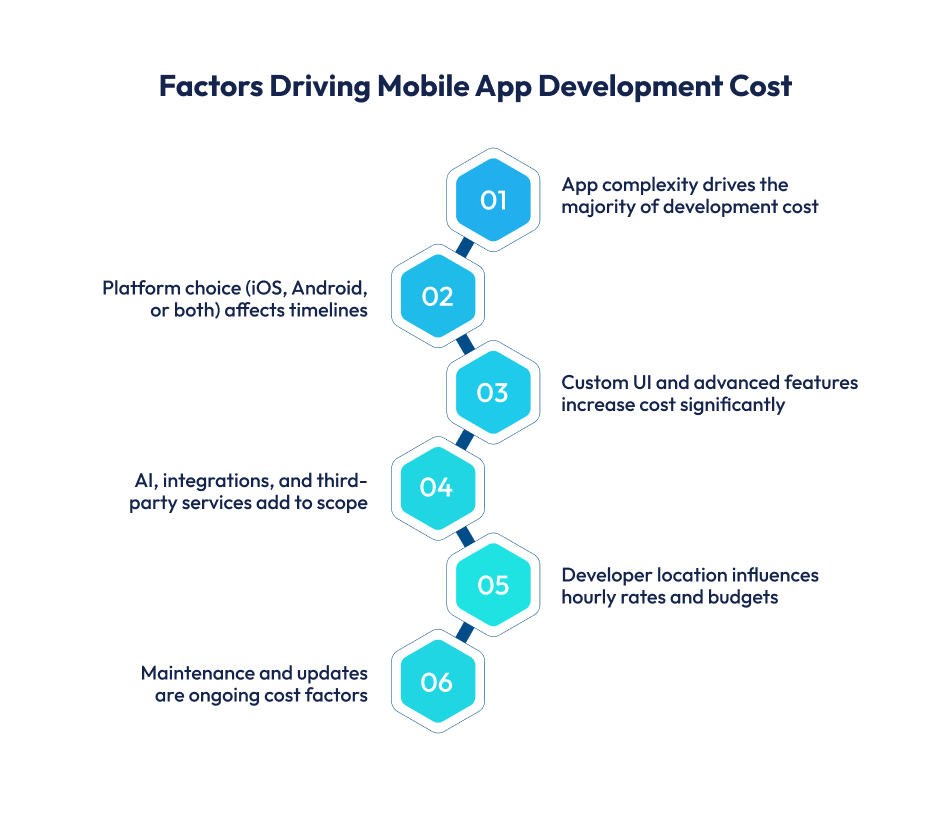
However, one of the first questions business owners ask is, "How much does mobile app development cost?" The reality is that there is no fixed answer. The total investment depends on several technical and business-related factors that influence the project's scope, timeline, and complexity.
Understanding the Cost Factors in Mobile App Development helps businesses create realistic budgets, prioritize features, and avoid unexpected expenses during development. This guide explains the primary cost drivers and how you can make informed decisions before starting your project.
Why Mobile App Development Costs Vary
No two mobile applications are exactly alike.
A simple appointment booking application requires fewer resources than an enterprise solution with AI-powered recommendations, real-time messaging, cloud synchronization, and advanced analytics.
The development cost depends on your business objectives, the number of features, technology stack, integrations, security requirements, and future scalability.
Instead of focusing only on the initial price, businesses should evaluate the long-term value that a well-built application delivers.
1. Type of Mobile Application
The type of application has a major influence on development costs.
An informational app with static content is relatively inexpensive because it requires minimal functionality.
Business applications involve customer accounts, dashboards, reports, notifications, and database management, increasing development effort.
Marketplace, healthcare, fintech, and on-demand service applications require advanced functionality such as secure payments, real-time communication, GPS tracking, and high-level security, making them significantly more expensive.
The more complex the business model, the greater the investment required.
2. Feature Complexity
Features are one of the biggest Cost Factors in Mobile App Development.
Basic features include user registration, login, profile management, search functionality, and simple content management.
Advanced functionality such as payment gateways, chat systems, AI recommendations, video streaming, geolocation, biometric authentication, QR code scanning, and multilingual support requires additional development time and testing.
Businesses should prioritize essential features for the first release and introduce advanced capabilities in future updates.
3. Platform Selection
Businesses must decide whether to develop for Android, iOS, or both platforms.
Native development provides excellent performance and platform-specific optimization but often requires separate codebases and development teams.
Cross-platform frameworks allow developers to build Android and iOS applications from a single codebase, reducing both development time and overall project costs.
Choosing the right platform depends on your target audience, business goals, and available budget.
4. UI/UX Design
An attractive application alone is not enough.
Professional UI/UX design focuses on usability, accessibility, navigation, responsiveness, and customer satisfaction.
The design process includes user research, wireframing, prototyping, interface design, and usability testing.
Applications with intuitive navigation and visually appealing interfaces generally achieve better customer retention and higher ratings.
Although premium design increases the initial budget, it often improves long-term business performance.
5. Backend Infrastructure
Most modern mobile applications require a powerful backend system.
The backend manages databases, user authentication, APIs, cloud storage, notifications, business logic, analytics, and synchronization across devices.
As the number of users grows, the infrastructure must remain stable and scalable.
Building a secure and reliable backend requires careful planning and contributes significantly to overall development costs.
6. Third-Party Integrations
Businesses often connect mobile applications with external services to improve functionality.
Common integrations include payment gateways, CRM software, ERP systems, cloud storage, SMS providers, email services, social media logins, analytics platforms, and mapping services.
Every integration requires development, testing, maintenance, and sometimes recurring subscription costs.
While integrations increase project expenses, they also improve efficiency and enhance the overall user experience.
7. Testing and Quality Assurance
Developing a mobile application is only part of the journey. Before an app reaches users, it must undergo comprehensive testing to ensure it performs reliably across different devices and operating systems.
Quality Assurance (QA) includes functional testing, usability testing, performance testing, security testing, compatibility testing, and user acceptance testing (UAT). Thorough testing identifies bugs before launch, reducing the chances of poor reviews, app crashes, and customer dissatisfaction.
Although testing increases the initial budget, it significantly lowers long-term maintenance costs and protects your brand reputation.
8. Cloud Hosting and Infrastructure Costs
Most modern mobile applications rely on cloud services for data storage, authentication, file management, push notifications, and real-time synchronization.
Cloud infrastructure costs depend on server capacity, storage requirements, network traffic, database usage, and the number of active users. As your application grows, these operational costs also increase.
Choosing scalable cloud architecture ensures your application can support future growth without major system upgrades.
This is an excellent place to naturally include your first backlink to the Mobile App Development Services page on the Codexxa website.
9. Maintenance and Regular Updates
Launching a mobile application is not the end of development—it marks the beginning of continuous improvement.
Applications require regular maintenance to remain compatible with Android and iOS updates, improve security, fix bugs, and introduce new features based on customer feedback.
Businesses that allocate a maintenance budget keep their applications secure, stable, and competitive in a rapidly evolving digital environment.
Ignoring maintenance often results in outdated software, security vulnerabilities, and declining user engagement.
10. Development Team Expertise
The experience of your development team directly impacts both project quality and overall cost.
Skilled developers create efficient code, scalable architecture, and secure applications while reducing future maintenance requirements. Although experienced professionals may charge higher rates, they often complete projects more efficiently and with fewer errors.
When selecting a development partner, businesses should evaluate technical expertise, industry experience, communication, portfolio quality, and post-launch support rather than focusing only on price.
Practical Tips to Reduce Mobile App Development Costs
Reducing development costs does not mean compromising quality.
Businesses can optimize their budget by clearly defining project requirements, building a Minimum Viable Product (MVP), prioritizing essential features, choosing scalable technologies, and avoiding unnecessary design revisions during development.
Regular communication with the development team also helps prevent misunderstandings that can lead to delays and additional expenses.
Investing in proper planning at the beginning often saves significant costs later.
Common Mistakes That Increase Development Costs
Many businesses unintentionally increase project expenses through poor planning.
One common mistake is changing requirements repeatedly after development has started. Frequent revisions require additional coding, testing, and project management.
Another mistake is overlooking scalability. Applications built without future growth in mind often require expensive redevelopment later.
Some organizations also neglect security and testing until the final stages, making issues more costly to fix.
Choosing an inexperienced development team based solely on low pricing can also result in technical debt, project delays, and higher maintenance costs.
Best Practices for Budget-Friendly Mobile App Development
Successful projects begin with a clear business strategy and realistic expectations.
Conduct market research before development, define measurable objectives, and prioritize features that solve real customer problems.
Implement agile development practices to release updates incrementally, collect user feedback, and continuously improve the application.
Security, performance optimization, and scalability should be considered from the very beginning rather than added later.
This section provides a natural opportunity to include your second backlink to the Flutter Development or another relevant Codexxa service page.
Cost Comparison by Application Category
| Application Category | Typical Complexity | Estimated Development Investment |
|---|---|---|
| Informational App | Low | Low |
| Business Productivity App | Medium | Medium |
| E-commerce App | High | Medium to High |
| Healthcare App | Very High | High |
| FinTech App | Very High | High |
| On-Demand Service App | High | High |
| AI-Powered Enterprise App | Enterprise-Level | Very High |
The exact investment varies depending on business requirements, integrations, security standards, and feature complexity.
Key Takeaways
The Cost Factors in Mobile App Development extend beyond coding. Project planning, feature complexity, design quality, backend infrastructure, testing, cloud services, maintenance, and developer expertise all influence the total cost.
Businesses that invest in strategic planning, scalable architecture, and continuous improvement often achieve higher returns while avoiding unnecessary expenses.
A mobile application should be viewed as a long-term business investment rather than a one-time development project.
Conclusion
Understanding the Cost Factors in Mobile App Development enables businesses to make informed decisions and allocate budgets more effectively. While development costs vary depending on application type, features, technology, and infrastructure, careful planning can significantly reduce unnecessary expenses.
Rather than selecting the lowest-cost solution, organizations should focus on building secure, scalable, and user-friendly applications that deliver lasting business value. Investing in experienced developers, modern technologies, and ongoing maintenance ensures your application continues to meet customer expectations and supports future growth.
By balancing quality, functionality, and long-term scalability, businesses can maximize the return on their mobile app investment and remain competitive in today's digital marketplace.
Call to Action
Planning to build a mobile application for your business? Start with a clear vision, prioritize essential features, and partner with experienced professionals who understand your industry and long-term goals. A well-planned mobile app not only improves customer engagement but also drives operational efficiency, strengthens your brand, and creates new opportunities for business growth.
Frequently Asked Questions (FAQs)
1. What is the biggest factor affecting mobile app development costs?
Application complexity has the greatest impact. The number of features, integrations, security requirements, and backend functionality all influence development costs.
2. Is cross-platform development more cost-effective than native development?
In many cases, yes. Cross-platform frameworks allow developers to use a single codebase for Android and iOS, reducing both development time and cost.
3. Why is UI/UX design worth the investment?
A well-designed interface improves user satisfaction, increases engagement, and reduces customer churn, making it a valuable long-term investment.
4. How much should businesses budget for app maintenance?
Maintenance requirements vary, but businesses should plan for ongoing updates, bug fixes, security improvements, and compatibility with new operating system versions.
5. Can small businesses afford custom mobile app development?
Yes. Many businesses begin with an MVP that includes core features and expand the application gradually as their business grows.
6. Why is testing important in mobile app development?
Testing ensures the application functions correctly, performs well across devices, protects user data, and delivers a positive user experience before launch.
7. How can businesses reduce development costs without sacrificing quality?
Define clear requirements, prioritize essential features, avoid unnecessary changes during development, choose scalable technologies, and work with an experienced development team.
8. Is mobile app development a good long-term investment?
Absolutely. A professionally developed mobile application improves customer engagement, streamlines business operations, enhances brand visibility, and creates new revenue opportunities, making it a valuable long-term digital asset.